
Table of Contents
A dewatering screen removes part of the free water from a wet bed of solids. Water drains through openings in the screen surface, while vibration helps organize and move the retained solids toward discharge. The result is a wetter feed becoming a more manageable, still-damp solid product. The screen is not an oven, and it does not normally remove all the moisture held between or within particles.
Think of washed sand leaving a processing line. Before drainage, the mixture may behave like a flowing slurry. After drainage, the sand can form a pile that is easier to move. The change comes from letting water escape while keeping enough of the solid material on the deck. Following the water and the solids separately is the clearest way to understand the process.
Two routes begin at the same inlet
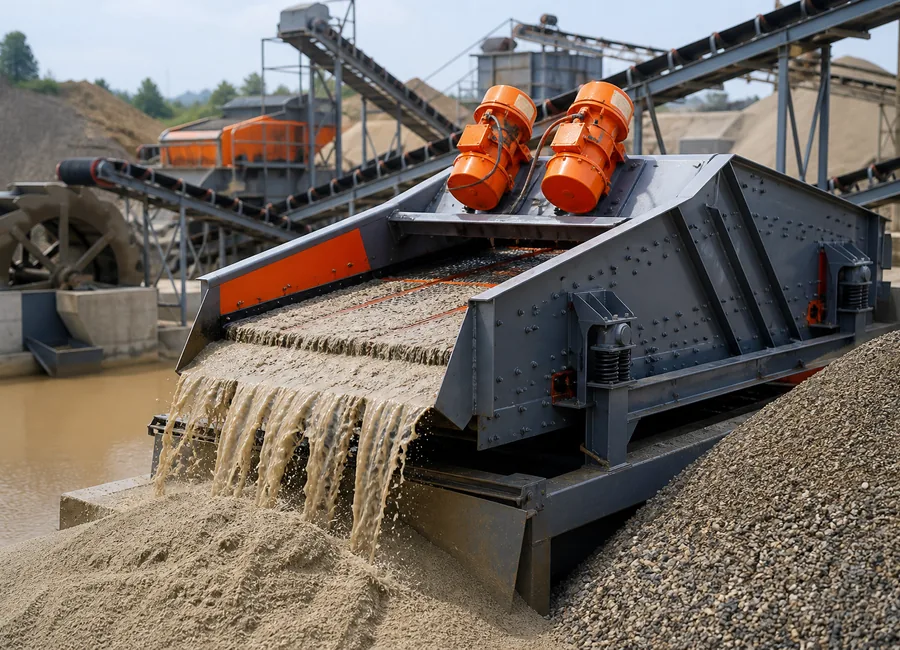
The feed contains solids and liquid together. On entering the screen, some water can find a path through the openings almost immediately. The solids need a supported route across the deck. As the bed develops, water continues draining through the spaces between the particles and then through the screening surface below them.
There are therefore two different discharge routes. Retained solids leave from the material outlet. Drainage water, often carrying fine particles, collects below the deck and must be directed to the next part of the process. The screen has not made that liquid disappear. It has separated a stream that still needs to be handled.
This distinction matters when watching a working machine. A strong flow underneath the screen can indicate active drainage, but it says nothing by itself about how much valuable fine material is also leaving. Likewise, a firm-looking sand pile does not prove a specific moisture percentage. Appearance is useful for observation, but measurement is needed for a numerical result.
Why the bed of solids is useful
A dewatering screen does not always work best with the thinnest possible layer. A developing bed gives the water a network of passages between particles. It can also retain some fine solids that might pass more readily through an uncovered opening. The solids and the screen surface act together during drainage.
This does not mean that a deeper bed is always better. An excessive depth can overwhelm the available drainage area or create uneven movement. If material piles up while the discharge cannot keep up, water may remain trapped in parts of the bed. The useful bed condition depends on the material, the incoming liquid, and the machine's design.
A simple comparison is a colander containing coarse gravel versus one containing fine wet sand. Water finds wide passages through the gravel. In the sand, the passages are smaller and the behavior is different. Both materials sit over openings, but their own structure strongly affects how water moves. The same principle helps explain differences between feeds on an industrial screen.
What vibration changes
The deck's repeated movement rearranges the solids and helps them travel toward discharge. That movement can open drainage paths and help release water that would otherwise remain trapped in a settled layer. It also changes how long material remains on the available surface.
Too little effective movement can leave a poorly moving, uneven bed. A change that makes material travel too quickly can reduce the time available for drainage. A more energetic appearance is therefore not a reliable measure of better dewatering. The relevant outcome is the condition of the discharged solids together with the solids lost in the drainage stream.
Different dewatering screens use different drives and deck arrangements. Some have high-frequency motion, and some use a deck profile that resists immediate discharge so a bed can develop. Those design choices should not be reduced to a universal rule that one speed or one angle is right for all wet materials. The feed must be part of the explanation.
Free water is easier to remove than all moisture
Free water can drain when it has a continuous escape path. Other water remains held in small spaces between particles, attached to their surfaces, or absorbed inside porous material. A vibrating screen mainly addresses drainage and mechanical water removal; it does not supply the thermal process needed to evaporate all that remaining moisture.
That is why “dewatered” and “dry” are different descriptions. Sand that no longer releases a visible stream can still feel wet and contain a measurable mass of water. Fine or porous solids may hold more water than a coarse, dense material under otherwise similar conditions. A universal final-moisture claim hides those differences.
If a process truly needs a low residual moisture level, it may require another operation after screening. Which operation is appropriate depends on the material and the purpose of the product. The useful question for understanding a dewatering screen is how much drainable water it removes at the stated conditions, rather than whether the discharge looks completely dry.
Fines explain many surprising results
Fine particles create smaller spaces through which water must travel. They can also leave with the liquid through the deck. A feed containing more fines can therefore change both drainage behavior and solids recovery. Even if the total incoming weight is unchanged, the balance between coarse and fine material can make the screen behave differently.
Clay-rich or sticky material adds another complication. It can coat surfaces, bind grains together, or form a bed with poor drainage paths. A screen that handles washed sand well should not automatically be expected to produce the same result with a clay-rich slurry. The material name alone may not reveal how large that difference is.
For a useful observation, compare samples from the feed, the solid discharge, and the drainage stream using the site's approved sampling method. If the water below looks cloudy, that is a reason to investigate suspended solids, not proof of a particular particle size or loss percentage. A size analysis or solids measurement is needed to establish those values.
A water balance makes the idea concrete
Consider an illustrative feed containing 100 kilograms of dry solids and 100 kilograms of water. Suppose 80 kilograms of water leaves through drainage and, just for this simplified example, no solids are lost. The discharge would contain 100 kilograms of solids and 20 kilograms of water, for a total of 120 kilograms.
On a wet basis, the moisture content in that discharge is 20 divided by 120, or about 16.7 percent. On a dry basis, it is 20 divided by 100, or 20 percent. Both numbers describe the same imaginary discharge using different denominators. Any moisture claim needs to identify the basis before it can be compared fairly with another claim.
Real operation also needs to account for solids in the drainage, water added elsewhere, and changes in material stored on the deck. The example is not a promise of screen performance. Its purpose is to show why a visible reduction in water must be connected to a defined measurement. “Eighty percent of incoming water removed” is not the same statement as “twenty percent final moisture.”
| Stream | Dry solids in the example | Water in the example |
|---|---|---|
| Feed | 100 kg | 100 kg |
| Drainage | 0 kg assumed | 80 kg |
| Retained discharge | 100 kg | 20 kg |
What an uneven discharge can tell you
If one side of the deck carries a thicker bed than the other, the drainage conditions are also uneven. Possible reasons include how the feed enters, the distribution of water, the state of the screen panels, and the level or condition of the installation. The visual pattern helps describe the problem, but it does not identify one cause on its own.
A sudden change is especially informative. Note whether the incoming material changed, whether rainwater entered storage, whether the upstream washing process changed, or whether a panel was recently replaced. Comparing those events is more useful than adjusting several settings at once and then trying to guess which one mattered.
All observation should be from a safe position. Screens combine moving structures, wet areas, and connected equipment. Clearing a blocked surface or inspecting panels requires the approved shutdown and isolation procedure. Material and water can continue arriving from upstream even after the local drive stops, so the whole connected route matters.
Relate the explanation to an actual screen
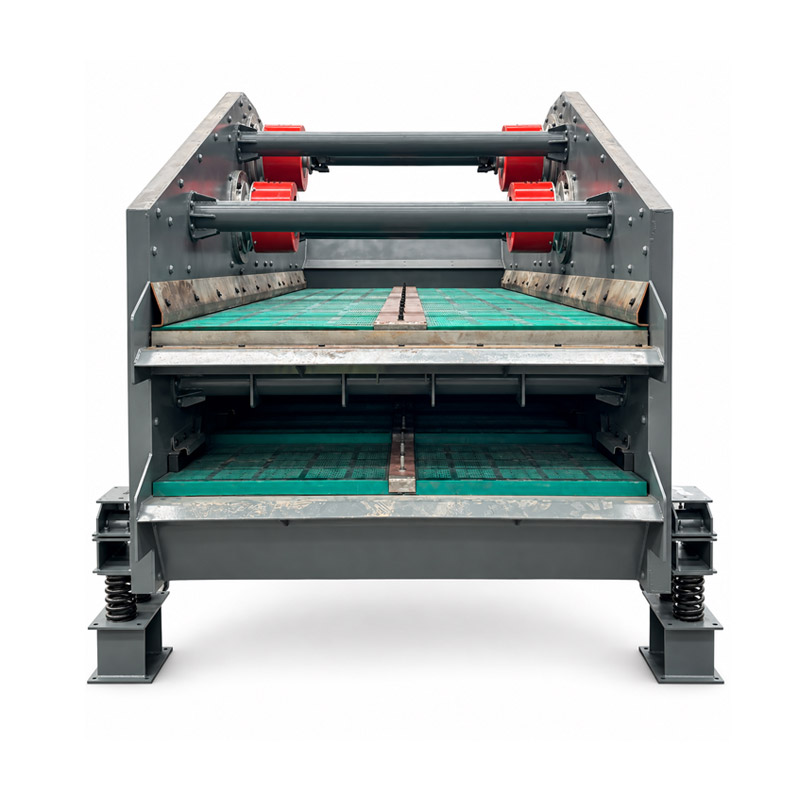
The high-frequency dewatering screen is one example of equipment intended for this kind of solids-and-water handling. Its suitability for a particular slurry still depends on the material and operating conditions. A product photograph is useful for recognizing the deck and outlets, but it cannot establish a guaranteed discharge moisture.
For a non-commercial introduction to the wider process, see Wikipedia's dewatering overview. When looking at a screen afterward, follow three things: the bed developing on top, the liquid leaving below, and the condition of the retained solids. Together, they explain where the water goes and why some moisture stays behind.
Does a dewatering screen make sand completely dry?
No. It removes part of the water mechanically. Surface moisture and water held in small spaces can remain in the discharged sand.
Why is the drainage water cloudy?
Suspended fine solids may be leaving with the liquid. Their amount and size need measurement; cloudiness alone does not quantify the loss.
Is a thicker material bed always better?
No. A suitable bed can aid drainage and retention, but excessive or uneven depth can reduce useful drainage and disrupt movement.
Why does final moisture change between materials?
Particle size, fines, porosity, surface behavior, feed water, and operating conditions all affect how much water remains after drainage.
Which moisture percentage should be reported?
Use the basis required by the process and identify it clearly. Wet-basis and dry-basis percentages have different denominators and should not be compared as identical values.