
Table of Contents
A vibrating screen separates a mixed material by size. Small particles find openings in a moving screen and fall through. Particles that cannot fit continue to another outlet. The vibration keeps the mixture moving, exposes buried particles to the openings, and gives each particle more chances to meet a suitable gap. The machine is sorting the mixture; it is not usually grinding every piece into a new size.
Picture a kitchen sieve containing rice and a little flour. Shake it gently and the flour falls through while the rice remains. An industrial screen uses the same basic idea, but adds a controlled feed, a powered motion, a supported screening surface, and separate discharge paths. Understanding those four parts makes the equipment much easier to read, even if you have never worked in a factory.
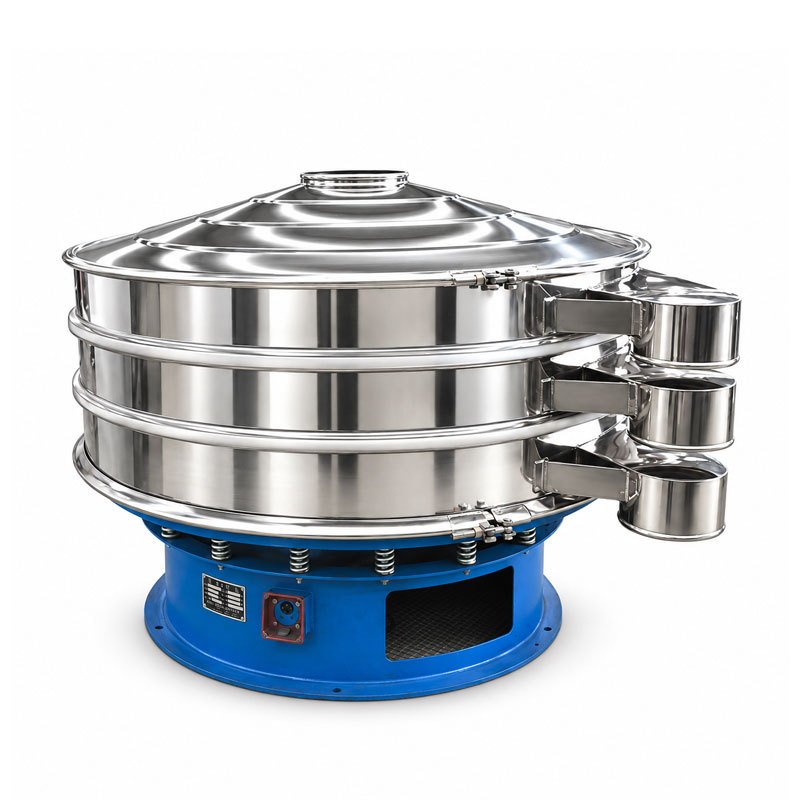
Start at the inlet, not at the motor
The inlet receives a mixture of sizes. A feeder may deliver a steady stream, or an operator may introduce material in batches through a suitable loading arrangement. What matters to separation is how that material spreads across the screen. A narrow heap uses only part of the available surface, even when the machine itself is wide.
At the start of the deck, particles often lie several layers deep. The smallest particles may be trapped beneath larger ones. They cannot pass through simply because they are small enough; first they must reach the surface. Vibration loosens and rearranges the bed so the smaller pieces can work down toward the openings. This rearrangement is called stratification.
The depth of the bed changes along the route. As fine material falls through, less material remains on top. A healthy-looking stream at the inlet therefore does not tell you what is happening at the far end. To understand the whole process, follow both the material staying on the deck and the material passing below it.
The opening is a doorway with a shape
A round grain much smaller than an opening can pass easily when it reaches that opening. A grain nearly the same size has a harder job: it needs a favorable position and sufficient opportunity. A thin, elongated particle may pass through in one orientation but remain on top in another. Size separation is therefore influenced by particle shape as well as nominal opening size.
This explains why a screen does not make a perfectly sharp mathematical cut. A little correctly sized material can leave through the coarse outlet because it never found an opening. Some awkwardly shaped pieces may enter the fine fraction. The amount of material close to the opening size often makes separation more difficult than the amount of very coarse material.
Mesh count and opening size are also different descriptions. Mesh count describes a repeated pattern in woven cloth, while the actual clear gap depends on the wire thickness and the mesh convention being used. For comparing two screens, an opening dimension in millimeters or micrometers is clearer than a bare mesh number. One millimeter equals 1,000 micrometers.
What the vibration contributes
The drive creates repeated motion in the screen body. Springs or other isolating supports allow that motion while limiting how much is transmitted to the surrounding structure. Depending on the machine, the deck may follow a largely straight path, a circular path, or a more complex movement. The material responds to that movement together with gravity and friction.
Some motions lift and advance the bed in many small steps. Others encourage material to spread around a round deck before it reaches a side outlet. A louder or more violent-looking motion does not automatically mean better screening. If material leaves too quickly, useful fine particles can remain in the coarse stream. If it moves too slowly, the bed can become too deep.
The movement must suit the material and the purpose of the screen. A fragile granule can break during rough handling. A damp powder may stick instead of rearranging freely. A mixture rich in near-size grains may need more effective contact with the surface. These are different problems, so turning up vibration is not a universal response.
Follow the two outlets
Material passing through a screen is called the undersize fraction for that deck. Material retained on it is the oversize fraction. Those terms describe the relationship to the opening; they do not necessarily describe good and bad product. In one process the useful product is the fine fraction. In another, useful granules stay on top while dust is removed below.
Imagine separating a dry mixture containing fine sand and larger pebbles. Sand falling through is the undersize. Pebbles traveling to the end are oversize. If the aim is clean pebbles, finding sand at the coarse outlet is a loss of separation quality. If the aim is recovering sand, the same observation also means recoverable material is being lost with the pebbles.
On a machine with several decks, each deck makes another size boundary. The top deck normally has the larger opening, so very large pieces leave first. Material passing it reaches a finer deck. With two suitable decks, the result can be three streams: coarse, intermediate, and fine. The order of the outlets depends on the machine layout, so it should be checked rather than guessed from the outlet height alone.
| What you see | What it can mean | What it does not prove |
|---|---|---|
| Fine material at the coarse outlet | Some fines did not pass in time | The openings are definitely too small |
| Large pieces at a fine outlet | Damage, bypass, or a shape effect may be present | More vibration will solve it |
| A deep heap at the inlet | Feeding or spreading may be limiting contact | Every part of the deck is overloaded |
| A quiet, steady outlet stream | Flow is reasonably consistent at that moment | Every particle is correctly separated |
Why the same machine behaves differently with wet material
Water can change the way particles stick together. A dry powder that flows as separate grains may form soft clusters when damp. A cluster behaves like a larger object until it breaks apart. It may remain above an opening even though its individual particles would fit through. Sticky material can also coat wires and reduce the effective opening area.
A wet screening process deliberately uses liquid to help separate or wash material. That is different from trying to run an unintended damp feed through a dry-screening setup. The liquid flow, collection arrangement, and suitability of the screen surface all become part of the process. A machine should not be treated as suitable for wet service simply because it has a metal body.
There is also a difference between sorting solids in liquid and removing water from solids. A dewatering screen is arranged to encourage drainage and move a bed of solids toward discharge. A general grading screen is arranged around particle-size fractions. Both have openings and motion, but their main jobs are different.
A useful way to watch a screen
Observe from the designated safe position with guards in place. Start by asking where material enters, where each fraction leaves, and whether the flow is steady. Watch whether the bed spreads across the width or follows one narrow lane. Then look at the discharged material, because the result matters more than how busy the machine appears.
Do not reach toward a running deck or remove a cover to improve the view. Detailed inspection, clearing, and sampling must follow the machine's instructions and the site's isolation procedures. A video of the external flow can help explain a problem without putting hands near moving parts, provided filming is allowed and the safe viewing position is maintained.
For a simple record, identify the feed material, its moisture condition, the opening size, and which stream contains the unwanted particles. Statements such as “sand remains with the stones after rain” are more useful than “the screen is weak.” They describe the separation problem and make it possible to compare conditions later.
Connect the principle to real equipment
A rotary vibrating screen shows how a compact round machine can create several discharge paths. A light linear vibrating screen shows a more direct travel route along a rectangular deck. The important distinction for a learner is the path taken by the material, rather than the shape of the outer cover.
For background terminology, Wikipedia's mechanical screening overview provides a useful non-commercial reference. Keep the central idea in mind as you explore different designs: vibration presents particles to openings, the openings separate by fit, and the outlets carry the resulting fractions away. The quality of the result depends on all three steps working together.
Does a vibrating screen crush material?
Its main purpose is separation. Some fragile particles may break during handling, but crushing is a different operation with a different objective.
Why do small particles sometimes remain on top?
They may be buried in a deep bed, carried away too quickly, stuck to larger particles, or unable to reach openings that are blocked or coated.
Is a round machine always a circular-motion screen?
No. The body shape and the movement are separate features. Check the actual drive and material path rather than relying only on the machine's appearance.
Does a finer mesh always improve the product?
Only if that opening matches the intended size boundary. A finer opening can reduce flow and reject useful material when the desired product is coarser.
What information helps explain a screening problem?
The material, moisture condition, opening size, feed pattern, and the outlet where unwanted particles appear provide a practical starting description.